

Protecteur thermique Moroccanoil: A guide to choosing and using heat protection
Key Takeaways
Heat protection is one part of a careful styling routine, not a substitute for sensible tool use. Product directions and your hair’s response should guide how you apply it.
- A heat protectant can help reduce the effects of hot-tool styling, but it does not make heat risk-free.
- Moroccanoil Perfect Defense is described as a lightweight, dry-aerosol heat-protective spray.
- Follow the product label for hair preparation, application distance, and drying instructions.
- Use controlled heat, work in sections, and avoid repeating passes over the same hair.
- When shopping, check the exact product and retailer terms before ordering.
What Moroccanoil thermal protection does
Heat styling can leave hair feeling dry or looking rough, especially when high temperatures or repeated passes become routine. A protectant is intended to help limit the effects of that exposure, while the tool technique and temperature still matter. The term protecteur thermique moroccanoil is often used for Moroccanoil’s heat-protection product, Perfect Defense.
How heat protectants help reduce styling damage
A heat protectant is applied before styling to help shield hair from some of the effects of heat. It is not a guarantee against damage, and the result depends on how the product is used alongside temperature, contact time, and frequency of styling. Think of it as one part of a careful routine, rather than permission to use the hottest setting.
The practical aim is to reduce unnecessary stress on the hair: use a suitable product, distribute it as directed, and avoid prolonged or repeated contact with hot tools. If your hair feels unusually brittle or looks more damaged over time, consider reducing heat styling and asking a professional for advice.
What to know about Moroccanoil Perfect Defense
Moroccanoil Perfect Defense is described as a dry, lightweight aerosol heat-protective spray. Its nourishing formula includes argan oil and vitamins, and the product description says it rehydrates hair while protecting it from the effects of heat styling up to 450°F/230°C. That stated limit is a product specification, not a recommendation to style at that temperature.
The directions describe using it at the start of a styling routine: spray evenly onto damp hair from about six inches away, comb through, then blow-dry and style with a heated tool. The directions also mention use on dry hair for next-day touch-ups. Check the current package for instructions before use, since packaging and directions are the practical reference for the item in hand.
Heat protection versus conditioning and hold
A heat protectant and a conditioner serve different roles in a routine. Conditioning products are used for hair care, while a heat-protection product is applied with heat styling in mind; neither label automatically means a product will provide lasting hold or a particular finish. The product description for Perfect Defense says it rehydrates hair, but it does not establish that it replaces a conditioner or styling product.
A useful way to decide what you need is to separate the goals. If you want a thermal barrier, choose a product labeled for heat protection; if you need conditioning or hold as well, look for those qualities in the appropriate product and follow each label. This keeps expectations realistic and helps avoid layering products simply because they are nearby.
Decide whether Moroccanoil Perfect Defense suits your hair
Whether a heat protectant suits you depends on how you style and what kind of finish you prefer. Product directions are more useful than broad assumptions based on hair type alone. Consider your tools, how often you use them, and whether you like a spray format before making a choice.
Consider your hair type and texture
Hair can respond differently to the same amount of product: fine hair may feel weighed down by excess, while dense or textured hair can take more time to coat evenly. The product description identifies Perfect Defense as suitable for all hair types, but individual preferences still vary. Start with the label’s directions and notice how your hair feels once it is dry.
If a spray makes your hair feel coated, adjust the amount or distribution rather than automatically applying more. For curls or waves, pay attention to whether you can reach the layers underneath without saturating the outer surface. A stylist can help tailor a routine if you are unsure how your hair responds.
Match the formula to your styling routine
The product directions describe using Perfect Defense before blow-drying and heated-tool styling, as well as on dry hair for touch-ups the next day. That makes the label a sensible starting point if your routine includes heat, but it is still worth checking the package for the exact directions. Match your application to the tool and styling schedule rather than treating every spray as interchangeable.
For a broader routine, consider what else you use before or after heat styling. The store lists options such as Moroccanoil Original Hair Treatment, Moroccanoil Moisture Repair Shampoo, and Moroccanoil Hydrating Shampoo, along with Moroccanoil Smoothing Lotion. Their names indicate different product categories, so check their own labels rather than assuming any one of them provides heat protection.
Weigh the finish, feel, and product format
Perfect Defense is described as a dry aerosol spray with a lightweight feel. A spray can be convenient for covering sections, though a fine mist still needs to be distributed thoughtfully; the goal is even coverage, not a damp or sticky coating. If you prefer to handle a small amount of product at a time, consider whether an aerosol format fits your habits and space.
Fragrance, finish, and texture are personal preferences, and the available description does not settle how every person will experience them. If you are sensitive to fragrance or have a particular ingredient concern, review the current ingredient list and packaging before purchasing. When in doubt, seek advice from a qualified stylist or health professional.
Apply the protectant before heat styling
Application is straightforward, but sequence and coverage matter. Follow the directions for the specific product rather than relying on a general rule for all sprays. For Perfect Defense, the available directions call for damp hair before styling and also describe dry-hair use for touch-ups.
Prepare clean, dry, or damp hair as directed on the label
Start by checking whether the product is intended for damp or dry hair and when it belongs in the styling routine. Perfect Defense directions say to use it at the beginning of the routine, before other styling products, and to spray it onto damp hair before combing and blow-drying. They also describe use on dry hair for next-day touch-ups.
These directions are specific to the product, not a universal rule for every protectant. If the package you have differs, follow that label. Avoid applying a product in a way the directions do not describe, especially before using a hot tool.
Distribute the product evenly without oversaturating
The directions for Perfect Defense specify spraying generously and evenly from about six inches away, then combing through damp hair. Even coverage helps avoid leaving some sections untreated while others are overly wet. Work methodically, particularly through the layers that are easy to miss around the back of the head.
A simple sequence can make application easier to repeat consistently:
- Divide hair into manageable sections before spraying.
- Hold the aerosol at the distance stated on the label.
- Apply across each section rather than concentrating in one spot.
- Comb through as directed, then check for missed areas.
That sequence is a practical guide, not a reason to exceed the amount on the package. If hair feels soaked, pause and let it dry rather than adding more product.
Let the product dry before using hot tools
Follow the product directions for the blow-drying step and make sure hair is dry before using a hot tool that is meant for dry hair. Applying direct heat to wet product-coated hair can create excess moisture and uneven styling, while a rushed routine can lead to repeated passes. Give yourself enough time to dry and section the hair properly.
The label’s sequence for Perfect Defense is to comb through damp hair, blow-dry, and then style with a heated tool. Keep that order in mind, and consult the package if you are using the product differently. If you are unsure whether a section is dry, wait rather than testing it with a hot iron.
Adjust your routine for different styling tools
Different tools expose hair to heat in different ways, so application and technique should suit the tool. A blow-dryer uses moving air, while curling irons and flat irons bring heated surfaces close to the hair. Protectant can be part of the routine, but it does not remove the need for controlled heat and careful handling.
Use a blow-dryer with controlled heat and airflow
Before blow-drying, apply the product according to its label and comb through if directed. Keep the dryer moving and use airflow to guide hair rather than holding concentrated heat in one place. A nozzle can help direct airflow, but avoid pressing the dryer against the hair or scalp.
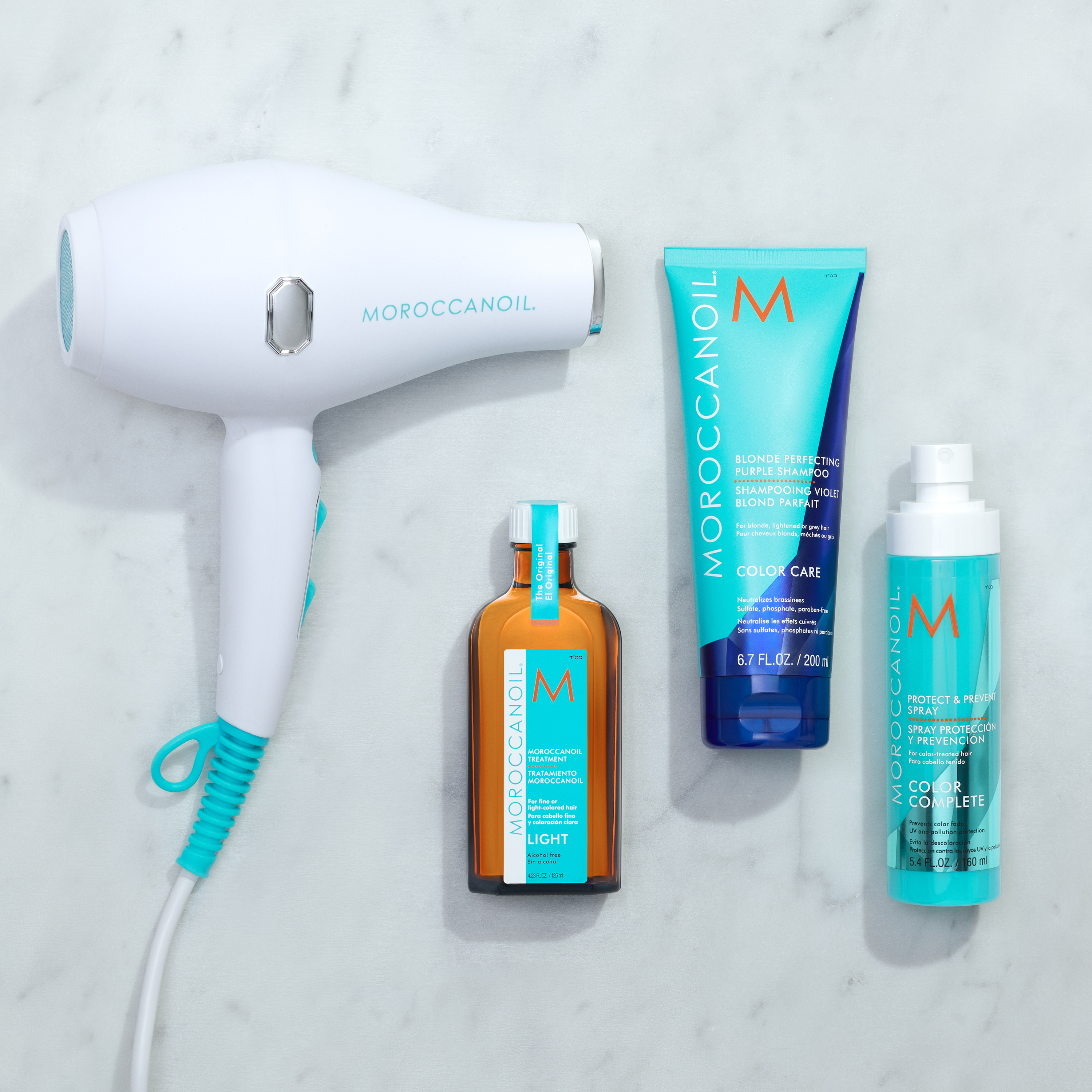
The product directions for Perfect Defense specify applying it to damp hair, combing, and proceeding with a blow-dry. If a brush dryer is part of your routine, use its instructions and keep the same attention to heat and motion; the store lists a 4-in-1 blow dryer brush. Tool names alone do not establish a product’s heat settings or technique, so review the tool’s own instructions.
Protect hair before curling or waving
For curls and waves made with a heated tool, apply the protectant as directed and allow hair to dry before wrapping it around the barrel. Use sections that are small enough for the tool to reach evenly, and avoid holding a section against heat longer than needed to form the shape. If you use products for curl definition, remember that styling and heat protection are separate functions unless the label says otherwise.
The broader hair-care selection includes Moroccanoil Intense Curl Cream, Moroccanoil Curl Control Mousse, and the Shine Seal Duo. Those names point to curl or finish-related products, but they should not be treated as replacements for a product labeled for heat protection. Check directions before combining products.
Take extra care when flat-ironing
Flat-irons make direct contact with hair, so keep the hair fully dry and work with small sections. Use the lowest setting that gives you the result you want, and move the iron steadily instead of clamping repeatedly over the same length. A thermal protectant helps support a routine; it does not make repeated high-heat passes harmless.
If you use a flat iron, the store lists the Titanium Flat Iron. Before styling, read the tool’s instructions and make sure its temperature setting is appropriate for your hair. Keep the iron away from the scalp and avoid using it on hair that is damp or coated with a wet product.
Get better results while limiting heat exposure
The simplest way to reduce heat stress is to use less heat when possible. A protectant should sit within a wider routine of careful temperature choices, efficient sectioning, and breaks from hot tools. Small adjustments often make styling more consistent without turning every session into a long process.
Choose the lowest effective temperature
Begin at a lower temperature and increase only if needed for your hair and desired style. The highest setting is not automatically the most effective one, and a product’s stated heat-protection limit should not be read as a target setting. Tool instructions and your hair’s response should guide the choice.
If hair takes many passes to style, reassess the section size, dryness, and technique before turning up the heat. Consider letting hair air-dry partly before blow-drying, when that suits your routine. This can reduce the time spent using a hot tool.
Work in small sections and avoid repeated passes
Smaller sections can make it easier to style evenly, which may reduce the temptation to go over the same area again and again. Keep the tool moving at a steady pace, and pause if the result is not taking rather than immediately repeating the pass. Good sectioning also makes it easier to notice any area that still needs product coverage.
A consistent pattern is often more useful than rushing: divide the hair, style one section at a time, and set finished sections aside. If your hair feels hot, rough, or unusually dry, stop and let it cool. Change the routine before adding more heat.
Combine heat protection with gentle hair-care habits
Heat styling is only one part of hair care. Gentle detangling, suitable cleansing, and time away from hot tools can help keep a routine balanced. If scalp dryness is a concern, the store also has dry scalp treatments and a Moroccanoil Oily Scalp Treatment; review each product’s directions and intended use separately.
The broader catalog also includes Moroccanoil Volumizing Mist and Moroccanoil Volume Thickening Lotion. A product’s name can suggest its styling role, but its label is the place to confirm how it fits your routine. Keep heat protection, cleansing, conditioning, and styling goals distinct when choosing what to layer.
Shop for Moroccanoil thermal protection with confidence
When shopping online, make sure the item matches the product you intend to use and that the seller provides clear purchase terms. Heat protectants can have similar descriptions, so check the full name, package size, and directions. A little care before ordering can prevent confusion once a product arrives.
Check the product name and packaging details
Confirm that the listing identifies Perfect Defense and shows clear packaging and product information. Check size, ingredient details, and directions, especially if you are comparing a standard item with a travel format. For questions about fit, the store’s beauty and hair-care collection offers a broader view of available categories.
You can also browse Moroccanoil Hand Cream and Volume Discovery Set while reviewing the wider assortment, but keep the product purpose clear: those names do not identify a heat protectant. To find heat-protection options, browse heat protection and confirm the exact item before adding it to your cart.
Choose an authorized retailer to help avoid counterfeit or expired products
The retailer states that it is an authorized retailer for the brands it carries and sources products directly from brands. It also says regular shipments help keep inventory fresh. Shopping through an authorized seller can help reduce the risk of counterfeit or expired products, though checking the seller and the item details remains worthwhile.
Compare the product name and packaging in the listing with the details on the item when it arrives. If something seems inconsistent, contact the retailer before use. This basic check is especially helpful when buying cosmetics and hair products online.
Review shipping, samples, and purchase terms before ordering
Check shipping costs, delivery estimates, and the return or purchase terms shown at checkout. The retailer says orders are processed within one to two business days, with delivery taking up to seven business days depending on location; shipping is free over stated order thresholds in Canada and the U.S. It also says orders include free samples, and eligible orders over $75 can select a free gift in the cart.
The store’s wider catalog includes Ambiance de Plage Hand Wash, Dahlia Rouge Body Lotion, Ambiance de Plage Body Lotion, and Ambiance de Plage Shower Gel. These are examples of the assortment rather than heat-styling products, so review their separate product pages if you are shopping for them. Confirm the final order total and delivery details before placing your order.
Explore Heat Protection
If you are ready to choose a product for your styling routine, explore the heat-protection selection and check the label directions before you buy.
Conclusion
A good heat-styling routine pairs a suitable protectant with careful application, moderate tool use, and enough time to let hair dry properly. Check the product label, choose a temperature that works without excess heat, and adjust your habits when your hair needs a break.
Frequently Asked Questions
Should I use heat protectant every time I use a hot tool?
Use a product labeled for heat protection before heat styling, following its directions. How often you use hot tools is a separate choice; reducing frequency can help limit overall exposure.
Can I apply heat protectant to wet hair?
It depends on the product. Some directions call for damp hair before blow-drying, while others may specify dry hair, so check the label and let hair dry as directed before using a hot iron.
How much heat protectant should I use?
Follow the amount and application directions on the package. Apply evenly without leaving hair overly wet or coated, and avoid adding more just because one section feels different.
Does heat protectant prevent all heat damage?
No product should be treated as a guarantee against damage. Temperature, contact time, repeated passes, and how often you style all affect heat exposure.
Is a higher temperature better for faster styling?
Not necessarily. Start with the lowest temperature that works for your hair and style, and adjust technique or section size before turning up the heat.
Should hair be dry before using a flat iron?
Unless the tool is specifically designed for damp hair and its instructions say otherwise, hair should be fully dry before flat-ironing. Follow the directions for both the styling tool and the product you apply.
Can I use several styling products together?
Possibly, but check each label for order and compatibility. Keep the purpose of each item in mind, and avoid layering more product than your hair needs.







Laissez un commentaire