

Kérastase thermique: how to choose the right heat-protecting treatment for your hair
Key Takeaways
The right thermal product should match your hair’s condition, texture, and styling habits. Good application matters just as much as the formula.
- Choose a treatment according to dryness, frizz, or weakness.
- Apply heat protection to towel-dried hair before styling.
- Use enough product for even coverage without coating the roots.
- Adjust hot-tool temperature to your hair’s condition.
- Buy from an authorized retailer for fresher, authentic products.
What Kérastase thermique products do
Thermal treatments are leave-in products designed to sit between freshly washed hair and heated styling tools. They can help reduce the drying effect of blow-dryers, flat irons, and curling irons while making hair easier to shape. The best choice depends on whether your main concern is dryness, frizz, or weakened lengths.
How heat protection helps reduce styling damage
Heat can leave hair feeling rough, dry, and more prone to breakage, particularly when the same areas are styled repeatedly. A thermal product helps create a layer between the fiber and the tool, so hair is better prepared for the styling process. It does not make unlimited heat harmless, but it supports a gentler routine when paired with moderate temperatures and careful technique.
The difference between a heat-protecting cream and a blow-dry lotion
A cream usually feels richer and can be useful when hair needs more conditioning or protection from breakage. A blow-dry lotion or milk tends to spread lightly through damp lengths and may be preferable when you want movement without a heavy finish. Texture matters: thick or very dry hair often welcomes a cream, while fine hair may respond better to a lighter lotion.
When to use thermique products in your routine
Use a thermique product after cleansing and conditioning, once excess water has been removed with a towel. Work it through the hair before a blow-dryer, and follow the product directions if you also use a flat iron or curling iron. For a broader selection, you can shop heat protectants according to the styling step you use most often.
Choosing the right Kérastase thermique formula
Start with the condition of your lengths rather than choosing by name alone. Dryness calls for conditioning support, frizz calls for smoothing, and weakened hair needs a formula intended to help protect against breakage. Read the directions and consider how much product your hair can absorb without losing volume.
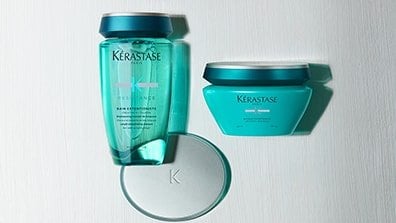
Nutritive Nectar Thermique for dry hair
Nutritive Nectar Thermique is described as a rich, heat-protecting nourishing leave-in cream for dry, medium to thick hair. It is applied to washed, towel-dried hair, especially through the lengths and ends, and left in before styling. If your hair feels parched after washing and usually benefits from richer conditioning, this type of cream may be a comfortable fit.
Kératine Thermique for frizz-prone hair
Kératine Thermique is a leave-in treatment intended to smooth and soften hair while helping prevent breakage and split ends. Its documented ingredients include Morpho-Keratine, Ceramides, and Xylose, with heat protection described as part of its use. It makes the most sense for hair that feels unruly, rough, or difficult to keep smooth during a blow-dry.
Résistance Ciment Thermique for weakened hair
Ciment Thermique is a heat-protecting leave-in cream for damaged, over-processed, or weakened hair. The source describes protection against heat up to 450°F, along with support for breakage and split ends through its Pro-Keratine Complex, Ceramides, and Resurrection Plant Sap. Choose this direction when the priority is strengthening and protecting fragile-looking lengths rather than simply adding softness.
How to match a formula to your hair’s needs
Hair rarely has just one concern, so rank the problem you notice most often. This simple comparison can help narrow the choice without treating a product as a universal fix.
| Main concern | Texture to consider | Product style to try |
|---|---|---|
| Dry, coarse lengths | Medium to thick | Rich leave-in cream |
| Frizz and unruly movement | Fine to medium or mixed | Smoothing blow-dry milk |
| Breakage or over-processing | Any texture | Strengthening leave-in cream |
After choosing a direction, test a small amount on the lengths and observe how the hair behaves once dry. The best match feels balanced: conditioned and protected, but not limp, sticky, or coated.
How to apply Kérastase thermique correctly
Application is where a good formula becomes useful in practice. Begin with clean, towel-dried hair and distribute the product gradually instead of placing one large amount in a single area. Keep the roots light unless the label specifically directs otherwise, since most heat styling happens through the lengths and ends.
How much product to use for short, medium, and long hair
There is no universal measurement because density, porosity, and texture change how much hair can absorb. Start with a small amount, emulsify it between your palms, and add more only if the lengths still feel uncovered. Short hair generally needs less than medium or long hair, while dense or thick hair may need a little more divided across sections.
Where to apply the product for even coverage
Focus on the mid-lengths and ends, where dryness and mechanical stress tend to show first. Smooth the remainder through the surface with your hands, then use a wide-tooth comb to distribute it. Avoid concentrating product at the scalp, especially if your hair becomes oily quickly or loses volume easily.
Applying thermique products to damp hair before blow-drying
After washing, gently squeeze out water and towel-dry until the hair is damp rather than dripping. Apply the leave-in, comb through, and begin drying soon afterward so the product is part of the styling process. A lighter option for dry, fine to medium hair is Lotion Thermique Sublimatrice, which is described as a leave-in blow-dry mist that conditions, detangles, and protects against heat up to 230°C.
The product should remain in the hair unless its directions say otherwise. If the hair still feels wet after application, remove more water before reaching for the dryer.
Why sectioning improves product distribution
Sectioning prevents the outer layer from receiving all the product while the underneath remains untreated. Divide the hair into a few manageable areas, starting at the nape and moving upward. This also lets you work with smaller amounts, which usually gives a more even finish and fewer overloaded patches.
A practical sequence is simple:
- Detangle gently from the ends upward.
- Divide dense hair into manageable sections.
- Smooth product through each section before combing.
- Recheck the ends before turning on the tool.
Once every section feels lightly coated, styling becomes more predictable. The goal is coverage, not saturation.
Using Kérastase thermique with hot tools
Thermal protection works best alongside sensible tool technique. Keep the dryer moving, avoid repeated passes over the same strand, and make sure hair is appropriately dry before using a direct-contact iron. If you frequently style, small improvements in temperature and section size can reduce unnecessary stress.
Blow-drying techniques for smoother results
Point the airflow in the direction of the cuticle, working from the roots toward the ends with a brush if you want a smoother shape. Use controlled sections rather than chasing the whole head at once. Finish each section before moving on, and let the hair cool briefly before disturbing the shape.
Preparing hair for flat irons and curling irons
Hair should be fully dry before using a flat iron or curling iron unless the tool is specifically designed for damp hair. Apply leave-in protection before blow-drying, then use only the amount recommended for your routine. Separate clean sections so the iron can make one controlled pass rather than several hurried ones.
Choosing the right temperature for your hair type
Begin at the lowest setting that gives you the result you want. Fine, porous, bleached, or already weakened hair generally calls for more caution than dense, resistant hair. The aim is not to find the hottest setting, but to use enough heat for the shape while limiting exposure time.
How often to use heat styling products
Use thermal protection whenever you use a heated styling tool, not only on wash days. If possible, alternate heat-styled looks with air-dried styles or lower-manipulation days. A leave-in treatment such as Thermique Régénérant is described as a heat protectant for all hair types and textures, but the broader routine still benefits from less frequent, less intense heat.
Building a complete routine around Kérastase thermique
Heat protection is one step, not a replacement for cleansing, conditioning, and occasional treatment. Build the routine around what your hair feels like after washing, then add styling products only where they solve a clear problem. This keeps the finish flexible and makes it easier to tell which product is helping.
Pairing thermique treatments with shampoo and conditioner
Choose shampoo and conditioner according to the needs of your lengths and scalp. For damaged or over-processed hair, Bain Décalcifiant Réparateur is described as a shampoo that targets calcium buildup, breakage, and dullness, while Fondant Fluidité Réparateur is described as a lightweight nourishing conditioner for damaged hair. Use one cleanser and one conditioner consistently before deciding whether the thermique step needs adjustment.
For color-treated hair, Bain Riche Chroma Respect is described as a sulfate-free shampoo that gently cleanses while helping maintain moisture and manageability. Keep the rest of the routine compatible with your hair’s color and texture rather than layering every treatment at once.
Adding a hair mask for extra dryness or damage
A mask can provide a more concentrated conditioning step when regular conditioner is not enough. Masque Réhydratant is described as a nourishing mask for dry, sensitive, and itchy scalps, while Masque Thérapiste is described as an intensive repair mask for very damaged, over-processed hair. Use a mask according to its directions, and allow the hair to show you whether weekly treatment is enough.
Combining heat protection with anti-frizz styling products
Layering can work, but each product should have a distinct job. A thermal leave-in prepares the hair for heat, while a finishing product can address flyaways or humidity after styling. For color-treated hair, Sérum Chroma Thermique is described as a smoothing leave-in spray that protects against heat, humidity, and frizz.
Avoiding product buildup and unnecessary layering
Too many leave-ins can make hair feel dull, waxy, or difficult to reshape. Keep the basic sequence straightforward: cleanse, condition or mask, apply one thermal product, then add a small amount of finishing product only if needed. Clarify or cleanse thoroughly when the hair no longer responds normally, and do not compensate for buildup by adding more styling cream.
When damage is severe, Sérum Thérapiste is described as a leave-in treatment for breakage, brittleness, and damage from heat styling or chemical treatments. It should be considered as part of a targeted repair routine, not automatically stacked with every other leave-in.
How to shop for authentic Kérastase products
Shopping carefully matters with any treatment applied directly to hair and scalp. An attractive price is not useful if the product is expired, counterfeit, or poorly stored. Look for a retailer that clearly explains its sourcing, inventory, and delivery practices.
Why authorized retailers matter
An authorized retailer can provide stronger reassurance about authenticity and freshness. Boutique Deauville states that it sources directly from brands, carries genuine products, and receives regular shipments. That matters because unauthorized online sellers can create uncertainty around product origin and shelf life.
Checking freshness, packaging, and product details
Compare the product name, size, ingredient information, and packaging with the manufacturer’s current presentation. Check the seal and container for damage, and contact the retailer if anything seems inconsistent. For very damaged hair, Soin Premium Therapiste is described as a treatment intended to repair and strengthen over-processed hair; the product should still be purchased from a source that can stand behind its authenticity.
Understanding samples, gifts, and shipping options
Samples and gifts can be useful, but they should not replace checking the actual item you ordered. Boutique Deauville states that orders include free samples and that customers can choose a free gift when the cart exceeds $75. Shipping terms also vary, so read the delivery information before placing the order.
What to consider when ordering in Canada or the U.S.
Check the currency, delivery threshold, carrier, and processing window before checkout. Boutique Deauville sells in CAD and USD, offers free shipping over $99 across Canada and over $150 across the U.S., and states that orders are processed within one to two business days. The retailer also says delivery can take up to seven business days depending on location, with UPS or Canada Post used for shipping.
For additional daily protection, Cicaplasme is described as a leave-in serum for hair exposed to heat styling, chemical treatments, pollution, or UV rays. If you are ordering from Canada or the U.S., confirm the address carefully and review the retailer’s policy for shipping issues before submitting payment.
Shop Your Hair Routine
Choose the treatment that fits your hair’s most pressing need, then explore the wider Kérastase collection for complementary cleansing, conditioning, and styling care.
Conclusion
Choosing kerastase thermique is less about finding one universal product and more about matching texture, damage level, and styling habits; with careful application and moderate heat, a simple leave-in step can make everyday styling feel more controlled.
Frequently Asked Questions
What is a thermique hair treatment?
A thermique treatment is a leave-in product used before heat styling. It helps prepare the hair for tools such as blow-dryers, flat irons, and curling irons.
Should heat protectant be applied to wet or dry hair?
Most leave-in thermal products are applied to washed, towel-dried hair before blow-drying. Always follow the directions on the specific product, especially if you plan to use a direct-contact iron afterward.
Can heat protectant make hair greasy?
It can if too much is applied or if the formula is richer than your hair needs. Start with a small amount, keep it away from the roots, and add only enough to lightly coat the lengths.
How often should heat protectant be used?
Use it whenever you use a heated styling tool. The frequency of protection should follow the frequency of heat styling, while reducing heat exposure where practical.
What temperature is safest for damaged hair?
Use the lowest temperature that creates the desired style. Damaged, bleached, porous, or fine hair usually needs more conservative settings and fewer repeated passes.
Is a cream or spray better for fine hair?
A light lotion, mist, or spray is often easier to control on fine hair because it can provide coverage without as much weight. Apply a small amount first and assess the finished texture.
Can heat protectant repair split ends?
It can help reduce additional stress and improve the temporary appearance of the hair, but it cannot permanently fuse split ends. Regular trims and gentler styling remain useful for managing them.




Leave a comment